



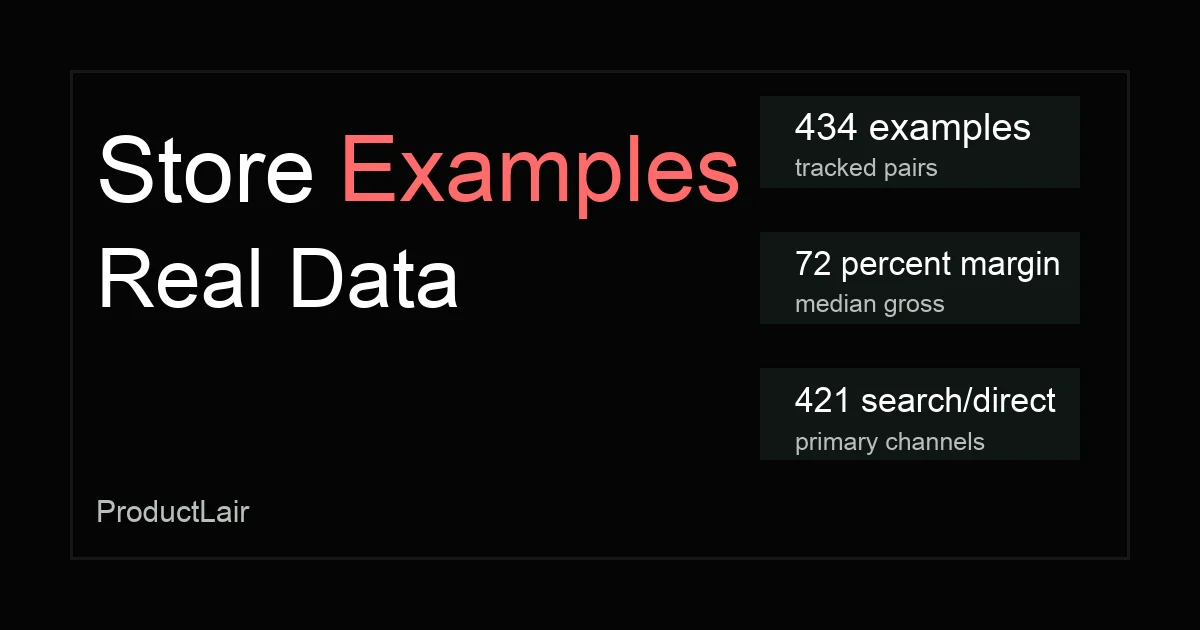
Dropshipping Store Examples 2026 (Real Store Data)
We analyzed 434 dropshipping store examples to compare real margins, traffic channels, product fit, and what successful Shopify stores do differently.

We analyzed 500+ million-dollar Shopify stores. Klaviyo dominates email (78%). See the exact apps 7-figure stores use and what they cost.
 By Anders Myrmel
Summarize with:
You found a winning product. Your ads are working. Sales are coming in. Now what?
Nobody talks about this, but the difference between a $100K store and a $1M store usually isn't the product. It's the boring stuff. The apps. The automations. The systems that make money while you sleep.
I looked at data from 500+ top Shopify stores to see what they actually run. Not what's trending on Twitter. Not what some guru recommends. What's actually installed on stores doing 7 figures.
Klaviyo for email. Not Mailchimp. Not Omnisend. Klaviyo. Over 60% of top stores use it. Brands switching to Klaviyo see 45% higher email revenue in 6 months. It's not even close.
Rebuy for upsells. This one surprised me. Stores using Rebuy see 20-32% higher order values. On a $92 average order, that's an extra $18-29 per customer. For free traffic you already paid for.
Judge.me for reviews. It's free. It works. 200,000+ stores use it. Don't overthink this one.
Gorgias for support. Most people miss this: support isn't a cost. Gorgias users report 75% more orders because happy customers come back. Wild, right?
That's the core stack. Everything else is optimization.
Before we go deeper, let me define some terms. Skip this if you already know:
Okay, moving on.
This isn't an exaggeration. Mature stores get 30-40% of their revenue from email and SMS. Not ads. Email.
Why? Because you already paid to get that customer. Email is basically free to send. Every dollar from email is almost pure profit.
| App | Price | Best For |
|---|---|---|
| Klaviyo | Free to 250 contacts, then ~$20/mo | 90% of stores |
| Postscript | From $100/mo | SMS-heavy brands |
| Attentive | Custom (expensive) | Enterprise only |
My take: Just use Klaviyo. Seriously. The only reason to use something else is if you're doing $10M+ and have specific enterprise needs.
The results speak for themselves. July (luggage brand) hit 230x ROI on their email spend. Harney & Sons (tea) drove 114x ROI. These aren't flukes.
Hot take: If your email revenue is under 25% of total revenue, you're leaving money on the table. Fix that before installing any other app.
No reviews = no sales. 93% of shoppers read reviews before buying. You need social proof.
But this is a solved problem. The apps are mature and cheap.
For most stores: Judge.me. It's free (or $15/mo for premium). It has a 5-star rating on Shopify. Their support responds in 40 seconds on average. What else do you need?
For scaling stores ($50K+/mo): Consider Okendo. It collects richer data (customer attributes, detailed feedback) and generates 3.4x more reviews than most competitors. Worth it when you need volume.
For enterprise: Yotpo bundles reviews with SMS, loyalty, and more. Overkill for most, but some big brands like the all-in-one approach.
According to Shopify's own comparison tool, Judge.me has the highest satisfaction rating. Start there. Upgrade later if needed.
Simple math that changed how I think about ecommerce:
That's what upsell apps do. They increase how much each customer spends.
Rebuy is the leader here. It uses AI to figure out what products to recommend. Not just "customers also bought" but actual machine learning that improves over time.
Real results from their case studies:
One agency ran A/B tests and saw +44% conversion rate with +191% AOV increase. That's not a typo.
My take: Rebuy costs $99/mo minimum. Don't install it until you're doing at least $10K/month. Before that, focus on getting more customers. After that, it pays for itself in days.
Most dropshippers treat support like a chore. Answer tickets. Handle refunds. Minimize cost.
Wrong mindset.
Good support = more sales. Gorgias users see 75% more orders after improving their support. Why?
Gorgias integrates with Shopify so your support team sees order history, tracking info, everything. No "can you send me your order number?" back-and-forth.
| App | Price | When to Use |
|---|---|---|
| Tidio | Free tier | Just starting out |
| Gorgias | From $10/mo | $10K+/month revenue |
| Zendesk | From $19/agent | Multi-platform businesses |
Be honest with yourself: If you're answering support emails from your personal Gmail, you're not ready for Gorgias. Start with Tidio's free tier. Graduate when you're drowning in tickets.
After Apple's iOS 14 update, Facebook and Google lie about your results. 85% of Apple users opted out of tracking. Your ad dashboard is showing you fantasy numbers.
This matters because you can't scale what you can't measure. You'll waste money on ads that aren't actually working.
Triple Whale is the standard now. 10,000+ DTC brands use it, generating $30B+ in combined revenue. It pulls data from everywhere (Shopify, ads, email) into one dashboard.
Elevar and Littledata focus on server-side tracking. They bypass ad blockers to capture conversions you're currently missing.
My take: You don't need this until $20K+/month. Before that, your sample size is too small anyway. After that, it's essential.
You don't need everything. More apps = slower site = fewer conversions. Each second of load time costs 7% of conversions.
Install only what you need for your stage:
Honestly? You need almost nothing.
Total cost: $0/month
Focus on finding products that actually sell. Apps won't save a bad product.
Now it gets interesting:
Total cost: ~$170/month
At $30K revenue, Rebuy's 20% AOV bump = $6K extra. The math works.
Full stack time:
Total cost: ~$1,200/month
At $100K/month, that's 1.2% of revenue. If these apps drive 20%+ of your sales (they should), that's a 15x+ return.
Installing 15 apps on day one. Your site loads like it's 1999. Customers bounce. You blame the product. It's not the product.
Skipping reviews because you're "just testing." No reviews = no trust = no sales. Even for testing, add Judge.me. It takes 10 minutes.
Treating support as a cost to minimize. The stores losing money have 48-hour response times and copy-paste responses. The stores winning respond in hours with actual humans. Big difference.
Obsessing over attribution too early. Triple Whale is great. But if you're doing $5K/month, your data isn't statistically significant anyway. Focus on getting sales first.
Klaviyo (free tier) and Judge.me (free). They cost nothing and do the most important jobs: email capture and reviews. Install these two before anything else.
Under $10K/month revenue: $0-50. Between $10K-$50K: around $150-200/month. Above $50K: budget 1-2% of revenue for apps. If they're not returning 5x+ what you pay, something's wrong.
For ecommerce, yes. Klaviyo was built for Shopify. The integrations are deeper, the abandoned cart flows work better, and the segmentation is more powerful. Mailchimp is fine for newsletters. Klaviyo is built for selling.
Yes. 93% of customers read reviews before buying. Even 5-10 reviews help. Judge.me is free, so there's no reason not to have it.
When you're consistently doing $10K+/month. Before that, focus on getting customers. After that, Rebuy pays for itself fast. A 20% AOV boost covers the $99/month in a few orders.
Live chat widgets, popup builders, and heavy analytics scripts. Test your site speed after each install. If it drops significantly, the app might not be worth it.
Need products to sell first? Check out our best dropshipping products for Shopify, the 2026 winning products guide, or browse the ProductLair database.
We analyzed 434 dropshipping store examples to compare real margins, traffic channels, product fit, and what successful Shopify stores do differently.
How to start dropshipping in 2026 with 5,943-product data, cost ranges, product filters, supplier checks, and a beginner launch plan.
Learn how to dropship on Shopify: set up your store, validate products with 5,943-product data, choose a Shopify dropship app, price correctly, and test traffic.