



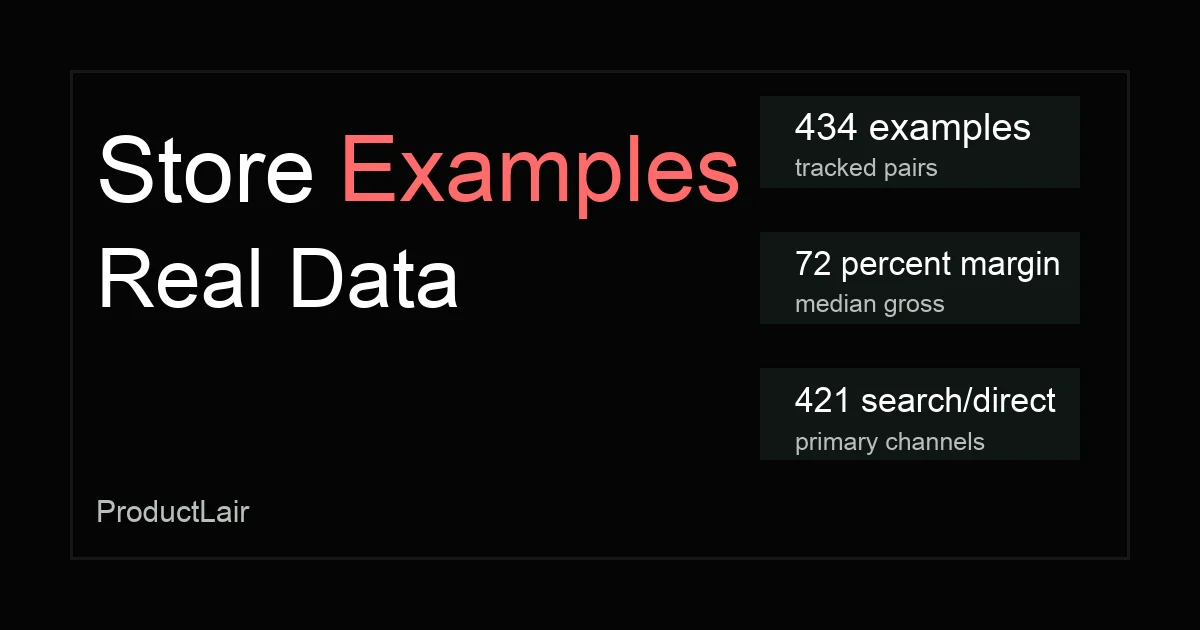
Dropshipping Store Examples 2026 (Real Store Data)
We analyzed 434 dropshipping store examples to compare real margins, traffic channels, product fit, and what successful Shopify stores do differently.

AI shopping agents are rewriting ecommerce. What agentic commerce means for dropshippers, the real fee math, and a practical readiness checklist.
 By Anders Myrmel
Summarize with:
Twenty-three percent of Americans bought something through an AI agent last month. Not through a website an AI recommended. Through the AI itself, without ever visiting a store.
This is agentic commerce: AI systems that research products, compare options, and complete purchases on behalf of consumers. ChatGPT now has Instant Checkout. Google launched the Universal Commerce Protocol. Shopify rolled out Agentic Storefronts. These aren't pilot programs. AI-driven orders on Shopify are up 15x since early 2025, and AI traffic to retail sites surged 1,200% year over year.
If you run a dropshipping store, this shift changes the rules. The question isn't whether AI agents will affect your business. It's whether your store is visible to them at all.
Agentic commerce is AI agents acting as autonomous shoppers. A consumer tells ChatGPT "find me a portable blender under $40 with good reviews," and the agent searches across stores, compares specifications, reads reviews, evaluates shipping times, and either recommends options or completes the purchase directly.
This is different from AI-powered product recommendations on a website. The agent never loads your homepage, never browses your collection pages, and never sees your carefully designed Shopify theme. It reads your product data through APIs and structured feeds. If your data is rich and machine-readable, the agent considers your products. If it isn't, the agent skips you entirely.
Three protocols now power this:
Universal Commerce Protocol (UCP): Co-developed by Google and Shopify, endorsed by Walmart, Target, Etsy, Visa, Mastercard, and 20+ other companies. An open standard that lets AI agents interact with any store's commerce backend, from product discovery through checkout.
Agentic Commerce Protocol (ACP): Built by OpenAI and Stripe, this powers ChatGPT Instant Checkout. Open-source under Apache 2.0 and available to any Stripe merchant. Shopify merchants can enable it in a few clicks.
Shopify Agentic Storefronts: A one-click setup that surfaces your products on ChatGPT, Perplexity, Microsoft Copilot, and Google AI Mode. Shopify also launched the Agentic Plan, a free tier that lets brands on any platform list in Shopify's AI-optimized product catalog.
Morgan Stanley estimates agentic commerce will drive $190 billion to $385 billion in US ecommerce spending by 2030. That's 10-20% of all online retail.
AI agents don't browse like humans. They evaluate structured data. And most dropshipping stores have terrible structured data.
We ran a comparison using our own product database. Our 273 curated products have 94 structured data fields across 16 related tables: attributes, variants, images, scoring dimensions, competitor pricing, customer demographics, marketing channel data, and search trends going back to 2019. Every product has 100% coverage on key features, scoring, market data, and customer geography.
Compare that to a typical dropshipping product listing. Our inventory scan of 5,943 products (raw data before curation) gives each product roughly 25 flat fields. No attributes. No variants. No structured competitor data. Even basic fields like dimensions (15% filled), weight (19% filled), and color (42% filled) are mostly empty.
That gap matters. Shopify's own research found that in one audit, AI agents ignored over 40% of a US Shopify catalog due to missing structured attributes. Stores hitting 95% or higher attribute completion saw 3-4x more AI visibility.
1. Thin product data. Most dropshippers import listings directly from suppliers. These descriptions are often machine-translated, missing GTINs and UPCs, and have no standardized attributes. An AI agent comparing a dropshipping listing with "cool blue light, very nice" against an Amazon listing with exact lumens, dimensions, weight, and material specs will always choose the Amazon listing. Writing better product descriptions helps with human shoppers, but AI agents need structured fields, not just better copy.
2. Slow shipping. AI agents compare shipping times. Standard AliExpress dropshipping delivers in 7-21 days. Amazon delivers in 1-2 days. Branded D2C stores ship in 3-5 days. When an agent is optimizing for the buyer, longer shipping times become an automatic disqualifier, especially in categories where customers expect fast delivery.
3. No reviews. Trust signals are core to how AI agents rank products. A new dropshipping store has zero reviews and no purchase history. An AI agent choosing between your product and the same item on Amazon with 2,000 reviews will always recommend Amazon. This compounds the competition challenge that dropshippers already face.
4. No brand recognition. Research from Columbia Business School found that AI agents make consumer choices more predictable, favoring "statistically common" options. Products from recognized brands get selected more often. Dropshipping stores selling white-label products from unknown brands start at a structural disadvantage.
Even if an AI agent does surface your product, the economics might not work.
ChatGPT Instant Checkout charges a 4% fee on every sale processed through their system. That's on top of Shopify's payment processing fees (2.9% + $0.30 for Basic plans). For a dropshipper already working with tight margins, that additional 4% can wipe out profitability on certain products.
Here's the math on a typical product:
| Line Item | Amount |
|---|---|
| Selling price | $29.99 |
| Product cost (COGS) | $8.00 |
| Shipping cost | $3.50 |
| Shopify processing (2.9% + $0.30) | $1.17 |
| ChatGPT checkout fee (4%) | $1.20 |
| Gross profit | $16.12 |
| Gross profit without ChatGPT fee | $17.32 |
That 4% fee represents a 7% cut of your gross profit on this product. For lower-margin items, the hit is steeper. A product with a 25% gross margin loses nearly a fifth of its profit to the ChatGPT fee alone. The income math that already challenges many dropshippers gets harder with another fee layer.
Google AI Mode and Microsoft Copilot don't currently charge extra platform fees, making them more attractive channels. But there's no guarantee that stays free as adoption grows.
The takeaway: factor AI agent fees into your pricing strategy now. If you're running thin margins on certain products, the ChatGPT checkout fee could push you below breakeven.
Not all categories face the same risk from agentic commerce. Commodity products with many sellers are most exposed. Unique or niche products are better protected.
High vulnerability:
Moderate vulnerability:
Lower vulnerability:
This is part of why evaluating products on uniqueness and differentiation matters more now than ever. Commodity products will face the most price pressure from AI-powered comparison shopping.
Here's what the enterprise guides miss: most small stores won't prepare for agentic commerce. That's the opportunity.
If 40% of products in a typical Shopify catalog are invisible to AI agents due to poor data, and your competitor selling the same niche products does nothing about it, then enriching your product data gives you an immediate edge.
The stores that move first on structured data, shipping speed, and review collection will absorb a disproportionate share of AI-driven traffic. That traffic is growing fast: AI referral traffic to Shopify merchants is up 8x year over year. AI-driven traffic is rapidly becoming one of the most important marketing channels for ecommerce, alongside organic search and paid ads.
This isn't entirely new ground. If you've optimized for AI search visibility, you already understand that structured, specific, citable content performs better in AI systems. The same principle applies to product data. Detailed, machine-readable product information gets surfaced. Vague marketing copy gets ignored.
You don't need an engineering team or a six-figure budget. Here are practical steps sorted by impact and difficulty.
AI agents evaluate product attributes, not marketing copy. For every product in your store:
Schema.org markup tells AI agents exactly what your product data means. At minimum, add:
Most Shopify themes include basic Product schema, but it's often incomplete. Check yours with Google's Rich Results Test and fill the gaps. Complete schema is the lowest-effort, highest-return step you can take.
If you're on Shopify, enable Agentic Storefronts in your admin panel. This automatically surfaces your products on ChatGPT, Perplexity, Copilot, and Google AI Mode. It's the single fastest way to get AI visibility, and it takes minutes to set up.
Even if you're not on Shopify, you can sign up for the Agentic Plan (free) to list your products in Shopify's AI-optimized catalog.
This is the hardest problem for dropshippers, but potentially the most impactful for AI visibility. AI agents will deprioritize 14-day shipping when 2-day alternatives exist.
Options:
AI agents weigh reviews heavily in product ranking. Start collecting reviews before you need them:
This ties directly into customer retention. Repeat customers are your easiest source of reviews, and reviews feed the AI visibility loop.
Beyond product pages, make sure your site content is readable by AI systems:
These are the same practices that help your store rank in traditional search and AI-powered search alike.
Agentic commerce doesn't change what makes a profitable dropshipping product. Products still need healthy margins, manageable competition, and market demand. But it adds a new filter: AI discoverability.
When evaluating products, start asking:
The best dropshipping niches in an agentic commerce world are the ones where products have genuine differentiation and where consumers value curation over comparison. Products with high impulse buy appeal and strong viral potential tend to be less commoditized, making them harder for AI agents to substitute with cheaper alternatives.
You can explore categories and product scores on ProductLair's product directory to identify products with the combination of margins, uniqueness, and data richness that agentic commerce rewards.
Agentic commerce is not a 2030 problem. Key milestones have already passed:
Forty-five percent of consumers already use AI for at least part of their buying journey. Sixty percent expect to use AI shopping agents within the next 12 months. AI-driven traffic to retail sites grew 1,200% year over year through Black Friday 2025.
The stores that prepare now will capture this traffic. The stores that wait will wonder why their conversion rates keep dropping even though nothing else changed.
Dropshipping is not dead. But the version of dropshipping where you import products, write a quick description, and run Facebook ads is becoming harder every quarter. Agentic commerce is one more reason to invest in product data quality, shipping speed, and genuine differentiation.
If you're starting a dropshipping business, build these habits from day one. If you're scaling an existing store, audit your product data this week. The AI agents are already shopping. The only question is whether they're shopping at your store.
Agentic commerce is when AI agents (like ChatGPT, Google AI Mode, or Perplexity) autonomously research, compare, and purchase products on behalf of consumers. Instead of a human browsing your store, an AI agent reads your product data through APIs and structured feeds, evaluates your products against competitors, and either recommends options or completes the purchase directly.
ChatGPT Instant Checkout lets consumers buy products directly inside ChatGPT without visiting your Shopify store. When a user asks for product recommendations, ChatGPT surfaces relevant products and allows one-click purchasing. Shopify merchants can enable this through Agentic Storefronts in their admin panel. Orders flow through your normal Shopify order management. ChatGPT charges a 4% fee per transaction on top of standard Shopify payment processing fees.
It depends on the platform. ChatGPT Instant Checkout charges a 4% fee on each sale, on top of your existing Shopify payment processing fees (2.9% + $0.30 on Basic plans). Google AI Mode and Microsoft Copilot do not currently charge additional platform fees. Shopify's Agentic Plan is free to join. The 4% ChatGPT fee can significantly impact margins on lower-priced dropshipping products.
Yes, but it takes deliberate effort. AI agents evaluate products based on structured data quality, shipping speed, reviews, and price. Most dropshipping stores are weak on all four. The opportunity is that most small stores aren't preparing for agentic commerce yet, so investing in product data, shipping, and reviews now creates a real competitive advantage. Focus on niche or differentiated products rather than commodities where Amazon and established brands will always win.
AI agents need structured, machine-readable product data. At minimum: product title, detailed description, price, availability, shipping time and cost, images, GTINs or UPCs, product attributes (material, dimensions, weight, color), variants, and customer reviews. Products with 95% or higher attribute completion see significantly better AI visibility. Schema.org markup (Product, Offer, AggregateRating) helps agents parse your data correctly.
UCP is an open standard co-developed by Google and Shopify that enables AI agents to interact with any store's commerce backend. It covers the full shopping journey from product discovery through checkout. Endorsed by Walmart, Target, Etsy, Visa, Mastercard, and 20+ other companies, UCP is designed to be the shared infrastructure that connects AI agents with merchants regardless of platform.
Start with these steps: (1) Enable Agentic Storefronts in your Shopify admin to surface products on ChatGPT, Perplexity, and Google AI Mode. (2) Enrich product data with structured attributes, GTINs, and complete variant information. (3) Add Schema.org markup for Product, Offer, and Review types. (4) Improve shipping times with US or EU warehouse suppliers, or use hybrid fulfillment for best sellers. (5) Collect customer reviews through automated post-purchase emails. (6) Write specific, measurable product descriptions rather than vague marketing language.
No. AI agents create both threats and opportunities for dropshippers. The threat is commoditization: if an agent can find the same product cheaper with faster shipping elsewhere, it will. The opportunity is differentiation: stores with rich product data, fast shipping, and genuine reviews can capture AI-driven traffic that competitors miss entirely. The dropshipping model still works, but it requires more investment in data quality and logistics than it did two years ago.
We analyzed 434 dropshipping store examples to compare real margins, traffic channels, product fit, and what successful Shopify stores do differently.
Copy a dropshipping return policy template backed by 424 real products, shipping windows, refund-without-return rules, supplier terms, and category risk.
Is Amazon dropshipping profitable in 2026? See fee math from 5,943 products, review pressure, supplier risk, and margin rules before listing.