



How to Start Dropshipping in 2026 (Data Guide)
How to start dropshipping in 2026 with 5,943-product data, cost ranges, product filters, supplier checks, and a beginner launch plan.

We analyzed 434 dropshipping store examples to compare real margins, traffic channels, product fit, and what successful Shopify stores do differently.
 By Anders Myrmel
Summarize with:
Most lists of dropshipping store examples recycle the same names: Gymshark, Notebook Therapy, Inspire Uplift, BlendJet, and a few stores that may not be dropshipping anymore. They are useful for inspiration, but they rarely show the numbers a beginner needs: supplier cost, selling price, margin, traffic channel, product score, and competitor pricing.
We took a different route. ProductLair tracks product economics across curated dropshipping opportunities, including Shopify stores, competitor prices, channel mix, traffic estimates, and our 17-point product scoring system. This article uses that data to show what strong dropshipping store examples have in common.
One caveat: not every store below is still a pure dropshipping store. Mature brands often start with dropshippable products, then move into private label, wholesale, or owned inventory as they scale. Treat these as store and product-positioning examples for dropshippers, not proof that each brand is currently fulfilling every order through a third-party supplier.
For this analysis, we used the curated product table in ProductLair, not the broader raw inventory table. That matters because the curated table includes store-level data that the raw Amazon scan does not have.
The dataset includes:
| Data Point | Source Used |
|---|---|
| Product name, category, cost, shipping cost | Curated product table |
| Primary store name, URL, selling price, traffic estimate | shopify_store table |
| Competitor store names, prices, traffic estimates | competitor table |
| Wow factor, problem score, impulse score, margin score | dropshipping_criteria_scores |
| Organic search, direct, social, paid, referral mix | market_data and marketing_channel |
| Buyer age and geography where available | customer_age_distribution and customer_geography |
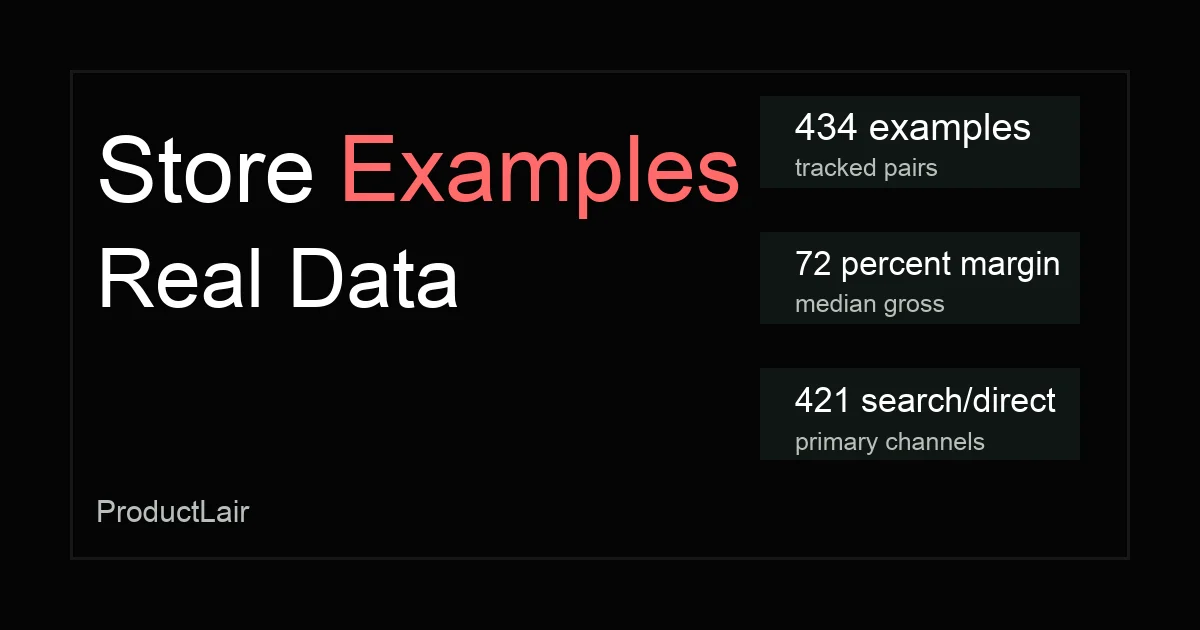
We filtered out rows without a valid selling price or positive gross profit. That left 434 usable product-store pairs, 419 unique primary stores, and 1,002 competitor-store rows.
The goal was not to crown "the best dropshipping stores" by revenue. It was to answer a more useful question: what does a store look like when a dropshippable product is packaged, priced, and marketed well?
The biggest surprise is how rarely social media is the primary channel.
| Primary Traffic Channel | Store Examples | Share of Dataset |
|---|---|---|
| Direct | 243 | 56.0% |
| Search | 178 | 41.0% |
| Social | 10 | 2.3% |
| Paid search | 2 | 0.5% |
| Referrals | 1 | 0.2% |
This does not mean TikTok, Instagram, or Facebook are useless. It means most successful-looking dropshipping store examples are not built on viral traffic alone. They get found through search, remembered by name, bookmarked, or revisited through brand demand.
That matches what we found in our deeper marketing channel analysis: search and direct traffic carry more product categories than social media does. Social works best when the product has clear demo value and high impulse appeal. Search works better when the buyer has a specific problem and is already looking for a solution.
The median economics are also stronger than most beginner assumptions:
| Metric | Median Across 434 Examples |
|---|---|
| Landed cost | $9.80 |
| Store selling price | $39.22 |
| Gross profit before ads | $28.34 |
| Gross margin | 72.0% |
| Markup | 3.6x |
| Monthly traffic estimate | 2,733 visits |
| 75th percentile traffic estimate | 17,001 visits |
These are gross numbers. They do not include ad spend, apps, payment fees, refunds, chargebacks, or your own time. For the full math, use our guide on how to calculate dropshipping profit margins and our break-even ROAS calculator.
The examples below are not ranked by size. They were chosen because each one teaches a different lesson about positioning, product economics, traffic fit, or store trust.
| Store | Product Tracked | Price | Landed Cost | Margin | Primary Channel |
|---|---|---|---|---|---|
| SwitchBot | Smart Door Lock | $199.99 | $98.73 | 50.6% | Search, 48.0% |
| BlendJet | Portable Juicer Blender | $59.95 | $18.76 | 68.7% | Direct, 53.2% |
| LifeStraw | Water Filter Straw | $33.19 | $4.81 | 85.5% | Search, 42.3% |
| SolaWave | Red Light Therapy Wand | $169.00 | $11.08 | 93.4% | Direct, 53.7% |
| The Beard Club | Mens Essential Beard Growth Kit | $75.00 | $3.16 | 95.8% | Search, 55.4% |
| StoveGuard | Stove Protector Mat | $109.99 | $0.99 | 99.1% | Direct, 40.5% |
| PhoneSoap | Electric UV Sterilizer Box | $69.95 | $7.84 | 88.8% | Direct, 52.1% |
| Bec Stewart | Productivity Cube Timer | $20.45 | $2.98 | 85.4% | Social, 54.0% |
| Zok | Migraine Relief Ear Pump | $28.99 | $0.99 | 96.6% | Social, 44.6% |
| SafetyMate | Portable Door Stop Alarm | $39.31 | $6.48 | 83.5% | Search, 64.8% |
SwitchBot is a useful example because the Smart Door Lock is not a cheap impulse gadget. The tracked selling price is $199.99 against a landed cost of $98.73, which leaves a 50.6% gross margin before ad costs.
The traffic pattern explains why this can work. Search is the primary channel at 48.0%, with paid search adding another 12.9%. The buyer is not scrolling TikTok and impulse-buying a smart lock. They are searching for a product that solves a specific security or convenience problem.
The lesson: high-ticket utility products need product-page depth. You need comparison tables, compatibility information, installation clarity, security claims, and visible support. Nielsen Norman Group's ecommerce product-page research makes the same point at the UX level: buyers need product pages that answer purchase questions before checkout.
If you are selling electronics dropshipping products, copy the search-first structure, not just the product type.
BlendJet is the obvious one-product-store lesson. The tracked Portable Juicer Blender sells for $59.95 against an $18.76 landed cost, a 68.7% gross margin. Direct traffic is the primary channel at 53.2%, which suggests strong brand recall.
This is what most beginners mean when they say they want a "one product store." The catch is that most products do not qualify. In our one product vs niche store analysis, only 1.6% of 5,943 products had the viral traits needed to carry a true one-product store.
BlendJet works because the product is visual, easy to understand, and repeatable in short videos. You can show the outcome in seconds. That is much harder with a commodity cable, a generic organizer, or a product that needs a long explanation.
The Water Filter Straw tracked under LifeStraw has a $33.19 selling price, $4.81 landed cost, and 85.5% gross margin. Search is the primary channel at 42.3%, with direct at 32.9%.
This is a classic problem-solver store example. The product scores 9 out of 10 on problem solving and 8 out of 10 on impulse buy potential. The buyer understands the use case immediately: camping, emergency kits, hiking, travel, and clean water access.
The lesson is that a store can sell a simple product at a healthy margin when the positioning is credible. A water filter straw is not just a gadget. It is preparedness, safety, and outdoor confidence.
If you want products like this, start with recession-proof dropshipping products and evergreen product ideas, not viral trend lists.
The Red Light Therapy Wand tracked under SolaWave sells for $169 against an $11.08 landed cost, producing a 93.4% gross margin. Direct traffic is the primary channel at 53.7%.
That margin is possible because the store sells perceived transformation, not a plastic beauty device. The product scores 8 out of 10 on wow factor, 9 out of 10 on problem solving, and 8 out of 10 on perceived value.
Beauty is one of the strongest categories for this model because trust, reviews, before-and-after visuals, and routine-building all matter. The product page has to carry more proof than a novelty gadget page. Shopify's product page examples show how established brands use social proof, benefits, comparison points, and recurring-use framing to reduce purchase anxiety.
For more products in this lane, see our beauty dropshipping products guide and browse beauty and personal care products.
The Mens Essential Beard Growth Kit tracked under The Beard Club sells for $75 against a $3.16 landed cost, a 95.8% gross margin. Search is the primary channel at 55.4%.
This store example is less about the kit itself and more about audience ownership. "Men who want a better beard" is specific enough to build product bundles, subscriptions, content, upsells, and retention.
That matters because the best dropshipping stores rarely stay one-SKU businesses forever. They use the first winning product to learn the buyer, then expand around the same problem. Our customer retention analysis found that problem-solving products are stronger repeat-purchase candidates than pure novelty products.
The lesson: choose a buyer identity, not just a product. Beard care, pet anxiety, desk productivity, travel safety, and home organization all give you room to expand.
StoveGuard is the kind of example most beginners skip because it does not look exciting. The tracked Stove Protector Mat sells for $109.99 against a $0.99 landed cost, which creates a 99.1% gross margin in our data.
The product scores only 6 out of 10 on wow factor and 2 out of 10 on impulse buy potential. Yet it scores 9 out of 10 on problem solving, and the traffic mix is balanced: direct at 40.5%, search at 28.5%, and social at 18.1%.
That is the hidden store example most dropshippers should study. The product is not glamorous, but it solves a visible, annoying household problem. If the store can make the fit, cleaning, safety, and customization feel credible, it can sell a low-cost item at a premium.
This is also why product saturation is not just about how many stores sell the item. A commodity product can still work if your store owns a sharper use case or clearer buying experience.
The Electric UV Sterilizer Box tracked under PhoneSoap sells for $69.95 with a $7.84 landed cost and 88.8% margin. Direct traffic is the primary channel at 52.1%, and search adds 35.2%.
Hygiene products need trust. Buyers want to know whether the product works, what it fits, how long it takes, and whether the claim is credible. Weak stores in this category look like scam gadgets. Strong stores make the product feel like a legitimate daily-use device.
The practical lesson is to use proof carefully. Do not invent claims. Do not import fake reviews. The FTC's consumer reviews rule went into effect on October 21, 2024 and allows civil penalties for knowing violations involving fake or deceptive reviews. This matters for dropshipping because imported, manipulated, or AI-generated testimonials can create real legal risk.
Use real reviews, real product photos, clear specs, and plain-language claims. Our dropshipping social proof guide covers that trust stack in more detail.
Only 10 of 434 examples have social as their primary channel. The Productivity Cube Timer is one of them.
It sells for $20.45 against a $2.98 landed cost, giving an 85.4% gross margin. Social is the primary channel at 54.0%. The product scores 9 out of 10 on impulse buy potential, 8 out of 10 on problem solving, and 7 out of 10 on wow factor.
This is what a social-friendly product looks like: cheap enough to buy quickly, easy to demonstrate, and tied to a relatable pain point. It is not just "cool." It makes the viewer imagine a more organized desk, study session, or workday.
If you are trying to build around TikTok or Reels, compare your product against our viral product criteria before spending money.
The Migraine Relief Ear Pump tracked under Zok sells for $28.99 against a $0.99 landed cost, a 96.6% gross margin. Social is the primary channel at 44.6%, with direct at 30.0% and search at 22.0%.
This is not a pure novelty product. It scores 9 out of 10 on problem solving and 9 out of 10 on impulse buy potential. The social angle works because the pain is visceral. People with headaches or migraines understand the problem immediately.
The caution: health-adjacent products need careful claims, quality control, and clear return policies. We cover those risks in dropshipping quality control by category and dropshipping returns true cost.
The Portable Door Stop Alarm tracked under SafetyMate sells for $39.31 against a $6.48 landed cost, an 83.5% gross margin. Search is the primary channel at 64.8%.
This is a strong example for travel safety, solo travelers, students, and apartment dwellers. The buyer is likely searching phrases like "travel door alarm" or "hotel room security device." They are not browsing casually. They have a specific fear and want a concrete solution.
That makes the product a better fit for SEO, Google Shopping, comparison content, and problem-led landing pages than for broad social ads. For adjacent product ideas, browse ProductLair or start with low-competition dropshipping products.
After reviewing the full dataset and the 10 examples above, five patterns stand out.
The median tracked product has a 3.6x markup. Some examples go much higher because the store adds perceived value through positioning, proof, bundles, design, or audience specificity.
That does not mean you can put a 10x markup on anything. The store has to explain why the product deserves the price. If your page looks like a copied AliExpress listing, buyers will compare you to AliExpress. If your page feels like a focused brand, buyers compare you to the problem they want solved.
Our guide on how to price dropshipping products breaks down why the common 2x to 3x rule is often too simplistic.
Direct traffic is the primary channel in 56% of the dataset. That is a big clue.
Direct traffic often means people remember the store name, return through bookmarks, click untracked email links, or type the URL after seeing the brand elsewhere. The store is not just a landing page. It has some level of brand memory.
This is why a niche store usually beats a random general store over time. A store about beard care, migraine relief, travel safety, pet comfort, or desk productivity can earn repeat visits. A store selling five unrelated gadgets cannot.
Search is the primary channel for 178 examples. Those products tend to solve a problem the buyer can name: smart door lock, water filter straw, beard growth kit, travel door alarm, portable monitor, stove protector.
If your product solves a named problem, build for search:
Baymard's product page UX benchmark found that many ecommerce product pages still perform poorly on basic decision support, especially on mobile. Their product page UX research is a useful reference for Shopify product pages.
Only 10 examples are social-first. They have a clear profile:
| Product | Social Share | Why It Works |
|---|---|---|
| 3D Hologram Fan Projector | 81.1% | Visual demo, immediate curiosity |
| USB Cup Warmer | 63.1% | Relatable desk problem, low price |
| Digital Measuring Spoon | 57.4% | Simple demo, kitchen use case |
| 3D Car Model Photo | 56.4% | Personalization and gift appeal |
| LED Half Finger Glove | 54.8% | Night-use demo, visible utility |
| Productivity Cube Timer | 54.0% | Desk productivity pain point |
| Electric Face Firming Massager | 49.9% | Beauty transformation angle |
| Migraine Relief Ear Pump | 44.6% | Pain-led problem, impulse appeal |
| AI Translator Pen | 43.2% | High perceived value, strong demo |
| Bluetooth Vinyl Player Speaker | 34.7% | Novelty design and aesthetic appeal |
If your product does not show well in a three-second clip, social should probably be a support channel, not the whole strategy.
The best dropshipping store examples do not win because they use a flashy theme. They win because the buyer believes the store.
That trust comes from:
Many beginner stores fail here. They install more apps, add more badges, and copy more "winning" templates, but the page still does not answer basic buyer questions. Baymard's checkout security research also shows that perceived trust matters at payment, not just on the homepage.
Do not copy the product blindly. Copy the structure behind the product.
Generic store-example lists are useful, but they create bad habits.
Do not assume a famous brand is still dropshipping. Many mature brands move into private label, owned inventory, domestic warehousing, or wholesale. SaleHoo's store-example article makes this point indirectly by covering stores that have grown into broader brands, and ZIK Analytics' top stores page tracks current stores but does not replace product-level economics.
Do not copy a homepage without copying the acquisition model. A direct-heavy store may have email, repeat customers, influencers, organic search, or brand demand behind it. If you copy the design but not the traffic engine, you get the look without the economics.
Do not copy pricing without understanding the offer. A $29 product can sell for $99 if the page adds proof, fit, bundling, or urgency. The same price on a generic page looks like a scam.
Do not skip testing. Even strong-looking products fail. Our guide on how to test dropshipping products without wasting money gives a practical pre-test scorecard and budget range.
Use this framework before building your next Shopify store:
| Question | Strong Answer | Weak Answer |
|---|---|---|
| What problem does the product solve? | Specific and easy to name | Vague, novelty-only |
| What channel fits the product? | Search, social, direct, or paid based on buyer behavior | "TikTok because everyone says TikTok" |
| What is the landed cost? | Known supplier cost plus shipping | Guess from a random listing |
| What is the target selling price? | Tested against competitors and perceived value | Picked because it feels profitable |
| What proof does the page need? | Reviews, video, fit guide, comparison, policy | Badges and urgency popups |
| What is product two? | Logical bundle, accessory, refill, or adjacent item | No plan after the hero product |
If you can answer those six questions, you are building a store. If you cannot, you are building a page and hoping traffic fixes it.
The best dropshipping store examples to study are stores that show strong product positioning, clear traffic-channel fit, and enough margin to survive ad costs. In our dataset, useful examples include SwitchBot for search-led utility products, BlendJet for one-product brand memory, LifeStraw for mission-driven problem solving, SolaWave for premium beauty positioning, and Productivity Cube Timer for social-first demo products.
Not necessarily. Some mature stores may use private label, wholesale, domestic inventory, or hybrid fulfillment. We use them as dropshipping-relevant examples because ProductLair tracks the underlying product economics, competitor prices, store prices, and channel data. The safer takeaway is: study the positioning and product economics, not the assumption that every order is still dropshipped.
Successful dropshipping stores usually have a specific buyer, a clear product problem, real proof, enough gross margin, and a traffic strategy that matches the product. In our 434-example dataset, direct traffic was primary for 243 examples and search was primary for 178, while social was primary for only 10. That means brand memory and search intent matter more often than viral ads.
Copy the structure, not the surface. Study how the store explains the product, handles objections, shows proof, positions price, and builds trust. Do not copy the theme, logo, images, or product claims. A copied design without the same traffic source, margin, reviews, and offer will not perform the same way.
The best traffic channel depends on the product. Search works best for named problems like smart locks, water filters, and travel alarms. Social works best for products with fast visual demos and impulse appeal. Direct and email matter most when the store can build repeat purchases, subscriptions, or a memorable niche brand.
In this analysis, the median tracked store sold a $9.80 landed-cost product for $39.22, creating a 72% gross margin before ads and operating costs. That does not mean every store needs exactly 72%, but it does show why thin 20-30% margins are dangerous for paid traffic. Your margin has to cover ads, payment fees, refunds, tools, and failed tests.
A one-product store is better only when the product has unusually strong wow factor, impulse appeal, and demo value. In our broader 5,943-product analysis, only 1.6% of products had the traits needed to carry a true one-product store. Most beginners have better odds with a focused niche store that can add bundles, accessories, repeat purchases, and SEO content over time.
Start with competitor research tools, Shopify search operators, product-page examples, TikTok ad libraries, and product research tools. Then filter examples by product economics: selling price, landed cost, competitor prices, traffic source, reviews, and product-channel fit. A store is only worth copying if you understand why the product sells and how the store gets traffic.
The best dropshipping store examples are not magic templates. They are combinations of product economics, positioning, proof, and channel fit.
Our 434-example dataset shows that the median tracked product-store pair has a 72% gross margin, but the traffic pattern matters just as much as the margin. Direct and search dominate. Social-first stores are real, but rare.
If you are building your own store, start with the product math, then pick the channel, then design the product page around the buyer's objections. That is what the strongest examples have in common, whether they are still pure dropshipping stores or have already grown into mature ecommerce brands.
How to start dropshipping in 2026 with 5,943-product data, cost ranges, product filters, supplier checks, and a beginner launch plan.
Learn how to dropship on Shopify: set up your store, validate products with 5,943-product data, choose a Shopify dropship app, price correctly, and test traffic.

We filtered 5,943 products for the 15 best Shopify store picks. $15-60 sweet spot, proven demand, and real margin data.