



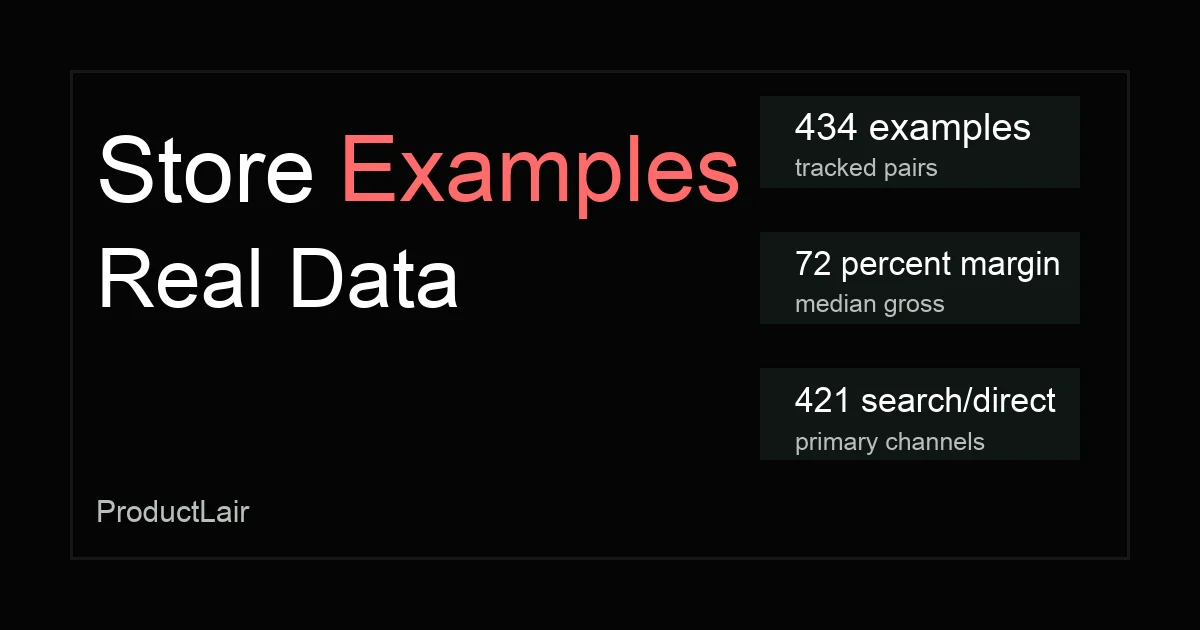
Dropshipping Store Examples 2026 (Real Store Data)
We analyzed 434 dropshipping store examples to compare real margins, traffic channels, product fit, and what successful Shopify stores do differently.

We analyzed 273 products to find which categories benefit most from email. Pets, Health, and Beauty score highest. Here's how to build flows that work.
 By Anders Myrmel
Summarize with:
Email drives 25-40% of revenue for well-run Shopify stores. For most dropshipping stores, email drives almost nothing.
We looked at the marketing channel data across 273 curated dropshipping products and found email accounts for just 0.12% of traffic on average. No product in our database exceeded 1%. Direct traffic (37.9%), search (34.1%), and social (10.8%) absorb everything. Email sits dead last.
That gap between 0.12% and 25-40% is the single biggest revenue opportunity most dropshippers are ignoring. Not because email doesn't work for dropshipping. Because most dropshippers never set it up properly.
Here's what our data says about which products benefit most from email marketing, which categories have the highest repeat purchase potential, and exactly which email flows to prioritize.
The logic sounds reasonable: dropshipping products are impulse buys. Customers buy once and never come back. Why invest in email when you could spend that time finding new customers through paid ads?
Three problems with this thinking:
1. Repeat customers are disproportionately valuable. Returning customers spend 3x more per visit than new ones. A 10% increase in repeat purchase rate can boost customer lifetime value by 25-40%. The second purchase is the critical inflection point: customers who buy twice are 45% more likely to buy a third time. Email is the primary tool for driving that second purchase.
2. Email has the highest ROI of any marketing channel. Ecommerce email marketing returns $45 for every $1 spent, the highest of any sector. Automated emails (flows) generate 30-41% of email revenue while making up just 2% of sends. Revenue per recipient for automated flows is 18x higher than for manual campaigns.
3. You're already paying for the traffic. Every customer you acquire through Facebook ads or TikTok cost you money. If they buy once and disappear, you've extracted a fraction of their potential value. Email lets you monetize customers you've already paid to acquire, which is far more profitable than constantly finding new ones.
The real question isn't whether email works for dropshipping. It's which products in your store deserve email investment.
Not all dropshipping products are equal when it comes to email. A novelty phone case someone buys on impulse has different retention potential than a pet grooming tool a dog owner uses weekly.
We scored 273 products on a retention composite: the average of their evergreen appeal (does demand persist year-round?), upsell potential (can you cross-sell related products?), and problem-solving value (does it address a recurring need?). Each dimension is scored 0-10.
Here are the categories that scored highest:
| Category | Products | Retention Composite | Evergreen | Upsell | Problem-Solving |
|---|---|---|---|---|---|
| Pets | 5 | 7.53 | 7.80 | 6.00 | 8.80 |
| Home Improvement | 7 | 7.43 | 8.14 | 5.57 | 8.57 |
| Travel | 6 | 7.33 | 7.50 | 6.00 | 8.50 |
| Health | 6 | 7.33 | 7.50 | 6.00 | 8.50 |
| Security | 7 | 7.33 | 7.29 | 6.00 | 8.71 |
| Health & Beauty | 6 | 7.33 | 8.00 | 5.83 | 8.17 |
| Health & Wellness | 23 | 7.28 | 7.83 | 5.61 | 8.39 |
| Beauty | 15 | 7.29 | 7.53 | 5.93 | 8.40 |
Bottom of the list: Collectibles (5.20), Toys & Hobbies (5.39), and Toys & Games (5.53). These are one-and-done purchases with low repeat potential.
The pattern is clear. Categories where products solve ongoing problems (pet care, health, home improvement) have the highest retention composite. These are the products worth building email flows around. Categories driven by impulse appeal alone (novelty toys, collectibles) are harder to retain through email.
This aligns with what we found in our customer retention analysis: products that address real needs generate repeat buyers, while novelty products rely on a constant stream of new customers. Email marketing amplifies that difference.
The strongest case for email marketing is consumable or replenishable products. These are items customers use up and need to reorder, or products with replacement parts they'll buy again.
We identified 73 products (26.7% of our 273 curated products) that fit this pattern. Here are examples with real margins:
| Product | Price | Margin | Why Email Works |
|---|---|---|---|
| Hair Growth Oil | $49.95 | 95% | Bottles run out in 4-6 weeks. Reorder reminder email at week 5 is almost guaranteed revenue. |
| Teeth Whitening Strips | $47.16 | 98% | Pack runs out after 2-3 weeks. Perfect for automated restock sequences. |
| Pet Grooming Steam Brush | $25.44 | 96% | Regular pet grooming drives accessory and replacement part purchases. |
| Foam Soap Dispenser | $36.71 | 70% | Refill soap cartridges create a recurring revenue stream after the initial sale. |
| Electric Cleaning Scrubber | $19.99 | 82% | Replacement brush heads needed every 2-3 months. |
For these products, a simple restock reminder email sent at the right interval can generate sales with zero ad spend. Industry data shows back-in-stock and reorder emails convert at 5.84%, nearly double the rate of welcome emails (2.84%).
If your store sells consumable products and you don't have restock emails running, you're leaving the easiest revenue on the table. Browse product categories on ProductLair to identify products with built-in repurchase cycles.
Email marketing investment needs to match your product economics. We grouped our 273 products by selling price and compared retention scores and margins:
| Price Tier | Products | Avg Margin | Retention Composite | Email Viable? |
|---|---|---|---|---|
| Under $15 | 33 | Negative | 6.67 | No. Margins can't support ESP costs. |
| $15-$30 | 75 | 73.4% | 6.98 | Conditional. Works for consumables with reorder flows. |
| $30-$50 | 62 | 71.9% | 6.84 | Yes. Enough margin for abandoned cart recovery alone to justify a tool. |
| $50-$100 | 62 | 71.7% | 6.69 | Yes. Post-purchase flows and cross-sells generate meaningful revenue. |
| $100+ | 37 | 76.0% | 7.10 | Strong yes. Highest retention scores and margins. Full email program pays off. |
Products under $15 have negative average margins in our data. Adding a $29-$59/month email tool to a store selling $12 products doesn't make sense. But for higher-ticket items above $30, even recovering a handful of abandoned carts per month covers the cost of any email platform.
The $100+ tier is the sweet spot: highest retention composite (7.10), highest margins (76%), and the highest absolute dollar value recovered per abandoned cart. If your store sells premium products and you don't have email flows set up, you're losing the most per missed opportunity.
Prioritized by impact and ease of setup. Start with flow #1 and add the rest as you grow.
About 70% of carts are abandoned before checkout. Abandoned cart emails recover 3-5% of those on average, and well-optimized sequences recover 10-20%.
The numbers make this flow a priority: abandoned cart emails see 50.5% open rates and $3.65 revenue per recipient. That's 18x higher than a standard promotional campaign.
Setup (3 emails):
| Timing | Content | |
|---|---|---|
| Reminder | 1 hour after abandonment | Product image, "You left something behind," direct cart link |
| Social proof | 24 hours | Customer review or rating, scarcity signal if applicable |
| Incentive | 48 hours | 10% discount or free shipping. Only use this as a last resort. |
For dropshipping specifically, address the two biggest conversion killers: shipping time uncertainty and trust. Include estimated delivery dates and your return policy in the email body.
Welcome emails see 4x higher open rates and 5x higher click rates than standard campaigns. This is when subscribers are most engaged.
Setup (3-4 emails over 7 days):
For dropshipping stores, the welcome series is critical for building trust. New visitors who signed up via a popup or lead magnet need reassurance that your store is legitimate before they'll buy. Include your shipping policy, contact info, and any press mentions or testimonials.
The post-purchase window is when customers are most receptive. They just trusted you with their money. Capitalize on that goodwill.
Setup (4-5 emails):
| Timing | Purpose | |
|---|---|---|
| Confirmation | Immediately | Order details, shipping timeline, set expectations |
| Shipping update | When shipped | Tracking link, estimated delivery, build anticipation |
| Delivery check-in | 3 days after delivery | "How's your product?" + usage tips |
| Review request | 7-10 days after delivery | Ask for a review. Include direct link. |
| Cross-sell | 14-21 days after delivery | Complementary products from the same category |
The review request email is especially valuable for dropshippers. New stores with few reviews struggle with trust signals. Automated review collection builds social proof on autopilot. Apps like Judge.me and Loox integrate directly with Shopify and your email platform.
The cross-sell email works best when you match it to the original purchase category. Our data shows categories like Beauty (5.93 upsell score), Pets (6.00), and Travel (6.00) have the strongest cross-sell opportunities. A customer who bought a pet grooming brush is likely interested in pet shampoo. Someone who bought travel accessories may want packing cubes.
If you sell any of the 73 consumable or replenishable products we identified, this flow generates revenue with almost no effort.
Setup: A single email timed to when the product runs out. For a 30-day supply, send at day 25. For replacement parts, send at the typical replacement interval (every 2-3 months for brush heads, every 4-6 weeks for oil and serum products).
Include a one-click reorder link. Reduce friction to zero. No browsing required.
Industry data shows restock emails from brands like Chewy drive 78% of their sales through auto-ship programs that started as simple email reminders. You don't need a subscription model to benefit from this principle. A well-timed "running low?" email works almost as well.
Customers who haven't purchased in 60-90 days are at risk of churning permanently. Win-back emails convert at 460% higher rates than promotional emails and can recover 20-30% of lapsed customers.
Setup (2-3 emails):
Keep in mind: acquiring a new customer costs 5x more than reactivating a lapsed one. If your ad costs are rising, win-back emails are the cheapest way to generate sales from people who already trust your brand.
Honest assessment: email isn't worth the investment for every store.
Skip email if:
Invest in email if:
Don't overthink the platform choice. The best email tool is the one you actually use.
| Revenue Stage | Recommended Tool | Why |
|---|---|---|
| $0-$5K/month | Shopify Email | Free up to 10,000 emails/month. Basic automations built in. Covers abandoned cart and welcome flows. |
| $5K-$50K/month | Omnisend or Mailchimp | Free tiers available, good automation builders, SMS integration. Omnisend is built for ecommerce. |
| $50K+/month | Klaviyo | Industry standard for Shopify. Deep segmentation, predictive analytics, best-in-class flow builder. Worth the price at scale. |
Start with Shopify Email. It's free, it's already connected to your store, and it handles the two highest-ROI flows (abandoned cart and welcome series) out of the box. When you outgrow it, migrate to a dedicated platform.
The most common mistake is spending weeks evaluating tools instead of setting up flows. A basic abandoned cart sequence on Shopify Email will outperform a perfectly configured Klaviyo account that never gets launched.
Every email flow depends on having subscribers. Here's how to build your list before you have significant traffic:
Pre-launch popup: Offer a discount (10-15% off first order) in exchange for an email address. This converts 3-5% of visitors. For a store getting 1,000 monthly visitors, that's 30-50 new subscribers per month.
Checkout opt-in: Enable the marketing consent checkbox at checkout. Most Shopify themes include this by default. Conversion rates are high because the customer is already in buying mode.
Content lead magnets: If you publish blog content or buying guides related to your niche, gate a downloadable PDF version behind an email signup. A pet store could offer "The Complete Guide to Grooming Your Dog at Home."
Post-purchase collection: You already have customer emails from orders. Make sure they're opted into marketing. Post-purchase emails should include a visible "subscribe for deals and new product alerts" link.
Organic social: If you're active on TikTok or Instagram, use link-in-bio tools to drive followers to a signup page with an incentive.
Don't buy email lists. Ever. Purchased lists destroy deliverability and violate CAN-SPAM and GDPR. Build your list with real subscribers who opted in.
Let's run the numbers on what email can realistically generate for a dropshipping store.
Assumptions: 1,000 subscribers, 70% cart abandonment rate, 200 orders/month, $40 average order value, 60% gross margin.
| Flow | Recovery/Conversion Rate | Monthly Revenue |
|---|---|---|
| Abandoned Cart (3-email series) | 8% of abandoned carts | $448 |
| Welcome Series | 2% of new subscribers convert | $80 |
| Post-Purchase Cross-sell | 5% of buyers purchase again | $400 |
| Restock Reminder (consumables) | 15% reorder rate | $300 |
| Win-Back | 5% of lapsed customers return | $100 |
| Total incremental email revenue | $1,328/month |
At $40 AOV and 60% margin, that's roughly $797 in additional gross profit per month. Shopify Email is free. Even Klaviyo at $30/month for 1,000 contacts delivers over 25x ROI.
These numbers are conservative. Omnisend's benchmarks show top-performing stores driving 40%+ of revenue through email. The difference between 0.12% and 40% is the difference between ignoring email and using it strategically.
Yes, if your products are priced above $15 with margins above 50%. Email returns $45 per $1 spent in ecommerce, the highest ROI of any marketing channel. Even basic abandoned cart emails recover 3-5% of lost sales. The key is matching your email strategy to your product type: consumable products and high-retention categories (Pets, Health, Beauty) see the best results.
Start with abandoned cart recovery (highest ROI), then add a welcome series. These two flows alone can generate 60-70% of your total email revenue. Once those are running, add post-purchase sequences, restock reminders for consumable products, and win-back campaigns for lapsed customers.
Well-optimized Shopify stores generate 25-40% of total revenue from email. During peak events like Black Friday, email and SMS can drive nearly 50% of revenue. If your store is below 15%, you likely have gaps in your automation flows or list-building strategy.
Start with Shopify Email (free up to 10,000 emails/month) to get your basic flows running. Move to Omnisend when you need better automation and SMS integration. Graduate to Klaviyo at $50K+ monthly revenue when you need advanced segmentation and predictive analytics. The platform matters far less than actually having flows set up and running.
Use a pre-launch popup offering 10-15% off the first order (converts 3-5% of visitors). Enable marketing consent at checkout. Add post-purchase email collection. If you create content, gate downloadable guides behind email signup. Never buy email lists: they destroy deliverability and violate anti-spam laws.
Based on our analysis of 273 products, categories solving ongoing problems score highest on retention potential: Pets (7.53/10), Home Improvement (7.43), Travel (7.33), Health (7.33), and Beauty (7.29). Categories driven by pure impulse appeal (Toys, Collectibles) score lowest and benefit least from email investment.
Automated flows (abandoned cart, welcome, post-purchase) send based on customer behavior, so they run themselves. For manual campaigns (promotions, new arrivals), 1-2 per week is the safe range for most dropshipping stores. Monitor unsubscribe rates: if they exceed 0.5% per campaign, you're sending too often or your content isn't relevant.
Yes. Abandoned cart emails have a 50.5% open rate and generate $3.65 revenue per recipient on average. A well-optimized 3-email sequence (reminder at 1 hour, social proof at 24 hours, incentive at 48 hours) can recover 8-15% of abandoned carts. For a store with $10K in monthly abandoned cart value, that's $800-$1,500 in recovered revenue.
We analyzed 434 dropshipping store examples to compare real margins, traffic channels, product fit, and what successful Shopify stores do differently.
Copy a dropshipping return policy template backed by 424 real products, shipping windows, refund-without-return rules, supplier terms, and category risk.
Is Amazon dropshipping profitable in 2026? See fee math from 5,943 products, review pressure, supplier risk, and margin rules before listing.