



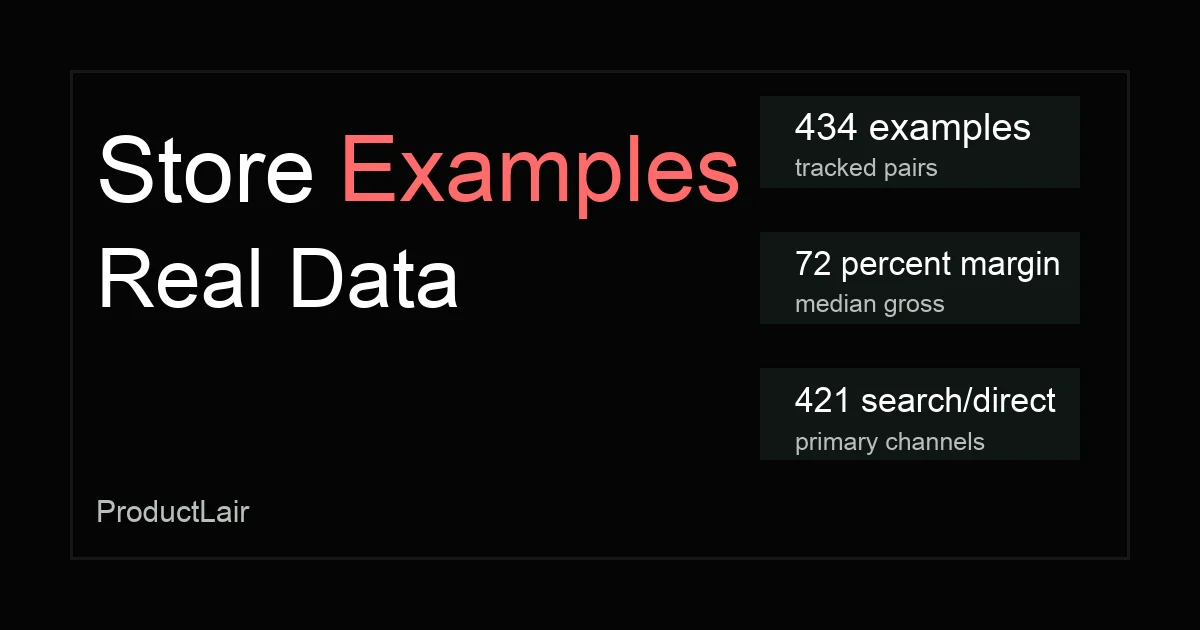
Dropshipping Store Examples 2026 (Real Store Data)
We analyzed 434 dropshipping store examples to compare real margins, traffic channels, product fit, and what successful Shopify stores do differently.

Walmart dropshipping in 2026: policy rules, fees, seller requirements, profitability, and 5,943-product data showing which products fit.
 By Anders Myrmel
Summarize with:
Walmart dropshipping in 2026 is not the same as listing an AliExpress product and letting a random supplier ship it. Walmart Marketplace crossed 200,000 sellers in 2025 and hit $150 billion in ecommerce revenue for the first time. Traffic reaches 438 million monthly visits. Referral fees start at 6%, there's no monthly subscription, and CPCs run 40 to 50% lower than Amazon.
On paper, it looks like the obvious next channel for dropshippers. The reality is more complicated.
We ran our database of 5,943 scored products through Walmart's fee structure, shipping requirements, and category rules. The results show that Walmart is a viable channel for a specific type of product, but most dropshipping catalogs don't fit. Here's the honest breakdown.
| Question | Short Answer |
|---|---|
| Is Walmart dropshipping allowed? | Yes, if you are the seller of record, control the customer experience, and use compliant suppliers or fulfillment partners |
| What is not allowed? | Buying from another retailer like Amazon, eBay, Target, or another marketplace and shipping that order directly to a Walmart customer |
| Best fulfillment setup | WFS, your own US warehouse, a 3PL, or a supplier that can ship in neutral packaging with valid tracking |
| Best product profile | $15 to $50 retail price, fast shipping, low return risk, strong reviews, and no chain-of-custody problems |
| Biggest risk | Walmart performance standards: late shipping, invalid tracking, cancellations, branded third-party packaging, and policy violations |
Want products that fit marketplace economics before you list?
ProductLair shows supplier cost context, margins, reviews, shipping signals, and category risk so you can filter for products that have a realistic chance on Walmart, Shopify, or other channels.
Browse curated productsBefore getting into product analysis, here's the current state of the platform:
| Metric | Value |
|---|---|
| Monthly website visits | 438 million |
| 3P marketplace sellers | 200,000+ |
| Active product listings | 420 million |
| U.S. ecommerce market share | 6.4% (#2 behind Amazon) |
| Online grocery market share | 31.6% (#1, ahead of Amazon) |
| Ecommerce revenue growth (Q4 FY26) | 27% YoY |
| Walmart+ members | 32 million |
| Physical U.S. stores | 4,606 |
Source: Walmart FY26 earnings, Marketplace Pulse
For comparison, Amazon has over 2 million active sellers and 37.6% market share. Walmart's seller base is roughly 10x smaller, which means less competition per listing. That gap is closing: Walmart added 44,000 sellers in the first five months of 2025, a 30% increase.
The customer base skews toward value-conscious families. The average Walmart trip involves 13 items at $54 total. Over 50% of online shoppers are married with children. Grocery dominance (31.6% market share, ahead of Amazon's 22.6%) means high purchase frequency and repeat traffic that carries over into non-grocery categories.
Walmart's fee model is simpler than Amazon's and cheaper in most categories.
| Category | Walmart | Amazon | Walmart Advantage |
|---|---|---|---|
| Consumer Electronics | 8% | ~15% | 7 points cheaper |
| Personal Computers | 6% | 8% | 2 points cheaper |
| Apparel (over $20) | 15% | 17% | 2 points cheaper |
| Home & Kitchen | 15% | 15% | Same |
| Toys & Games | 15% | 15% | Same |
| Pet Supplies | 15% | 15% | Same |
| Automotive | 12% | 12% | Same |
| Beauty (over $10) | 15% | 8-15% | Varies |
Source: Walmart referral fee schedule
The biggest difference isn't referral fees. It's the subscription:
| Fee | Walmart | Amazon |
|---|---|---|
| Monthly subscription | $0 | $39.99 |
| Annual cost | $0 | $479.88 |
| Listing fees | $0 | Free (up to 1.5M) |
No monthly fee means no break-even threshold before you start profiting. Amazon's $39.99/month means you need roughly 5 to 10 sales per month just to cover the subscription, depending on your margins. For sellers testing new products, that difference matters.
This is where Walmart's advantage is clearest:
| Metric | Walmart Connect | Amazon PPC |
|---|---|---|
| Average CPC | $0.50 - $1.00 | $0.85 - $1.30 |
| CPC difference | 40-50% lower | Baseline |
Source: PPC Ninja benchmarks
Lower CPCs mean your ad budget goes further. A product that costs $1.00 per click on Amazon might cost $0.55 on Walmart. At 100 clicks per day, that's $45 saved daily, or $1,350/month.
The catch: Walmart's ad platform is less mature. Targeting options are more limited, reporting is basic, and the attribution window (14 days vs Amazon's 7) can make ROAS calculations look better than they are.
Walmart is aggressively recruiting with up to $75,000 in savings for accounts going live after February 1, 2026:
These incentives are generous, but they expire. Build your pricing model on standard fees, not discounted ones.
Yes, but not the way most dropshippers think.
What's allowed:
What gets you banned:
Walmart's current packaging policy says Marketplace orders and packaging may not reference another marketplace, business, or fulfillment provider. It also says sellers may not purchase products from another retailer and have that retailer ship directly to the Walmart customer. Walmart's seller retailer policies warn that policy failures can lead to restrictions, suspension, or termination.
Performance standards that matter:
| Metric | Requirement |
|---|---|
| On-Time Delivery Rate | Over 95% |
| Valid Tracking Rate | 99%+ |
| Cancellation Rate | Under 2% |
| Refund Rate | Under 6% |
| Ship time | Within 2 business days |
Source: Walmart Seller Performance Standards
These requirements are strict. Fast handling alone disqualifies most traditional China-based dropshipping models. If your supplier takes 7 to 14 days to ship from Shenzhen, you can't meet Walmart's standards.
The beauty and health crackdown: In July 2025, Walmart required chain-of-custody documentation (proof of authenticity back to the manufacturer) for beauty, health, and cosmetics products. Thousands of sellers lost 75 to 90% of their listings overnight. If you sell in these categories, have your supply chain documentation ready before applying.
We modeled 5,943 products from our inventory database against Walmart's requirements. The results were sobering.
Walmart customers are value-focused. The platform converts best in the $15 to $50 range.
| Price Tier | Products | Share | Best Seller Rate |
|---|---|---|---|
| Under $10 | 1,801 | 30.3% | Below average |
| $10 - $15 | 798 | 13.4% | Marginal |
| $15 - $25 | 1,245 | 21.0% | 14.2% |
| $25 - $50 | 1,162 | 19.6% | 15.0% |
| $50 - $100 | 462 | 7.8% | 13.4% |
| Over $100 | 469 | 7.9% | 12.3% |
The $25 to $50 tier has the highest best seller rate at 15.0%, followed by $15 to $25 at 14.2%. Both outperform the 12.6% overall average. Products under $10 don't work on Walmart because the referral fee (15% of $10 = $1.50) leaves no margin after shipping costs. For pricing strategy, target the $20 to $40 retail price range for Walmart specifically.
That 30.3% of products under $10 is immediately disqualified. Another 13.4% between $10 and $15 is marginal. So roughly 40% of a typical dropshipping catalog is viable on price alone.
This is the biggest obstacle. Walmart expects 2-day shipping for competitive visibility. Our curated products score shipping time on a 0 to 10 scale:
| Shipping Speed Score | Products | Share |
|---|---|---|
| 3 (slow, 14+ days) | 139 | 47.3% |
| 4 | 31 | 10.5% |
| 6 (moderate) | 79 | 26.9% |
| 8 (fast) | 44 | 15.0% |
| 10 (fastest) | 1 | 0.3% |
Nearly half of all products (47.3%) have the slowest shipping score. Only 15.3% score 7 or above, the minimum for meeting Walmart's delivery expectations.
This is the fundamental conflict between traditional dropshipping and Walmart's model. Standard shipping from China takes 7 to 21 days. Walmart wants 2 to 4 days. Bridging that gap requires either US-based inventory (WFS or a 3PL) or suppliers with US warehouses.
Every one of our 294 curated products is manufactured in China. Zero are made in the US, Europe, or anywhere else.
This isn't unusual for dropshipping. The median product cost is $8.39, which is only achievable with Chinese manufacturing. But it creates two problems on Walmart:
The workaround is pre-shipping inventory to a US warehouse (yours, a 3PL, or WFS). This adds upfront cost but solves both the shipping and customs problems. For products in the $25 to $50 range with 50%+ margins, the warehouse economics can work.
We combined shipping speed, perceived value, and competition level into a basic readiness score. The results:
| Filter | Qualifying Products | Share |
|---|---|---|
| Relaxed (ship 6+, value 7+, competition 7 or below) | 16 | 5.4% |
| Strict (ship 7+, value 8+, competition 5 or below) | 0 | 0.0% |
Only 5.4% of curated products pass even relaxed Walmart-readiness criteria. Zero pass the strict filter. The bottleneck is almost always shipping speed: fast-shipping products with low competition and high perceived value are rare in a China-sourced catalog.
Cross-referencing our product scores with Walmart's category strengths reveals three clear winners.
Our top pick. 54.3% of Toys products fall in the $15 to $50 sweet spot, the highest of any category. Wow factor averages 2.91/5 (also highest), and social media potential hits 3.86/5. Walmart's core demographic (families with children) buys toys. The 15% referral fee is standard, and competition is lower than Amazon in most toy subcategories. Browse top-scored toys for specific product ideas.
49.0% in the sweet spot with a 14.5% best seller rate. Products like resistance bands, yoga mats, and camping gear align with Walmart's value-conscious customers. The 15% referral fee applies to most items, with 8% on hunting equipment and optics. See our fitness product analysis for margin data.
49.4% in the sweet spot with strong social media potential (3.64/5). Pet spending is growing year-over-year, and Walmart's customer base overlaps heavily with pet owners. Grooming kits, collapsible bowls, and training accessories work well. Check our pet products breakdown for category-specific scores.
Only 8% referral fee on consumer electronics, 7 percentage points cheaper than Amazon. The catch: electronics have the lowest best seller rate (8.6%) and higher return rates. Stick to accessories and gadgets under $50 rather than complex devices. Browse scored products in our electronics directory.
Beauty and Health: The July 2025 crackdown requires manufacturer chain-of-custody documentation. Unless you have direct supplier relationships with brand authorization, stay away.
Clothing: High return rates (Walmart's 30-day return policy is generous), sizing issues, and 15% referral fees on items over $20 eat margins. The 20.8% best seller rate is misleading because returns in apparel can hit 30%+.
Office Products: Lowest wow factor (1.88/5) and social media potential (2.81/5) of any category. Only 23% fall in the sweet spot. Commoditized and hard to differentiate.
Here's how margins work with Walmart's 15% referral fee (the most common rate), modeled against our product data.
Example: $30 retail product, $8 cost
| Line Item | Walmart | Amazon |
|---|---|---|
| Selling price | $30.00 | $30.00 |
| Referral fee | -$4.50 (15%) | -$4.50 (15%) |
| Fulfillment / shipping | -$5.00 | -$5.50 (FBA) |
| Product cost | -$8.00 | -$8.00 |
| Monthly subscription | $0 | -$1.00 (amortized) |
| Net profit | $12.50 (41.7%) | $11.00 (36.7%) |
Walmart wins by $1.50 per sale in this scenario, mostly from no subscription fee and slightly lower fulfillment costs. At 100 sales/month, that's $150 more profit.
The advantage grows at lower volumes. A seller doing 20 sales/month saves the full $39.99 subscription and roughly $30 in per-unit fee differences, totaling $70/month. For sellers just starting out, that's meaningful.
Across our 294 curated products at a 3x markup with 15% referral fee, 61.9% (182 products) are margin-viable on Walmart (over $5 profit and over 20% margin). The average dollar margin is $17.51 at 36.7%. For a deeper look at margin optimization, see our margin maximization guide.
Reddit's r/WalmartSellers paints a different picture than Walmart's marketing. The sentiment from active sellers is overwhelmingly critical:
Account suspensions without explanation: Multiple sellers with perfect metrics and years of history report suspension with no warning and vague reasons. One 8-year seller was paused for 14+ days for "business verification" despite changing nothing.
Seller support is poor: Copy-paste responses, cases closed without resolution, no escalation path. A seller who attended Walmart's own conference said: "The ROI on my time is just not there."
Return fraud is common: Sellers report 20% return rates with customers sending back different or used items. One seller compared: "I sell on Amazon too and my volume is 3x Walmart, but I have had maybe one fraudulent return on Amazon. On Walmart it happens a lot."
Revenue disparity: One seller reported $1.2M on Amazon vs $10K on Walmart in the same year. The traffic simply isn't comparable yet.
The consensus from experienced sellers: treat Walmart as a supplementary channel, not your primary one. Build on your own Shopify store first, then expand to Walmart once you have reliable fulfillment and established supplier relationships.
Walmart makes sense if you:
Skip Walmart if you:
The opportunity is real but narrow. Walmart's lower fees, less competition, and value-focused customer base create genuine advantages in the right categories. But the platform's strict shipping requirements, poor seller support, and return fraud issues mean it works best as channel #2 or #3, not channel #1.
For a broader comparison of selling channels, our Amazon FBA vs dropshipping analysis covers the economics in detail. And if you're evaluating which products to list where, AI-powered scoring tools can filter your catalog by platform fit.
Yes, but with restrictions. You must be the seller of record, and all customer-facing documentation must identify your business, not your supplier. Retail arbitrage (buying from Amazon or eBay to fulfill Walmart orders) is explicitly banned and will get your account terminated. You need approved suppliers who can ship with your branding, or use Walmart Fulfillment Services (WFS).
There is no monthly subscription fee. Walmart charges only referral fees per sale, ranging from 6% (personal computers) to 15% (most categories) to 20% (jewelry under $250). This is cheaper than Amazon's $39.99/month plus referral fees model. If you use WFS, fulfillment fees start at $3.45 per item for packages under 1 lb.
Based on our analysis of 5,943 products, the best categories are Toys and Games (54.3% in the $15 to $50 sweet spot, highest wow factor), Sports and Outdoors (49.0% in sweet spot, 14.5% best seller rate), and Pet Supplies (49.4% in sweet spot, strong social scores). Electronics under $50 benefit from Walmart's low 8% referral fee. Avoid beauty and health unless you have manufacturer chain-of-custody documentation.
Amazon has 10x more sellers but also significantly more traffic and a mature ecosystem. Walmart has lower fees (no subscription, CPCs 40 to 50% cheaper), less competition, and a growing customer base. Our data shows 61.9% of products are margin-viable on Walmart. The best approach: establish on Amazon or Shopify first, then expand to Walmart as a supplementary channel once you have US-based fulfillment. Read our full Amazon vs dropshipping comparison for the detailed numbers.
Orders must ship within 2 business days with valid tracking. If not updated to "shipped" with tracking within 4 calendar days, Walmart auto-cancels and refunds the customer. Your on-time delivery rate must stay above 95%, valid tracking rate above 99%, and cancellation rate below 2%. These requirements effectively prevent traditional dropshipping from China, where standard shipping takes 7 to 21 days.
Walmart charges no monthly subscription ($0 vs Amazon's $39.99/month). Referral fees range from 6 to 15% on Walmart vs 8 to 45% on Amazon. Electronics are notably cheaper: 8% on Walmart vs roughly 15% on Amazon. Walmart Connect CPCs average $0.50 to $1.00 vs Amazon's $0.85 to $1.30. The fee advantage is largest at lower sales volumes where Amazon's subscription eats into margins.
WFS is Walmart's equivalent of Amazon FBA. You ship inventory to Walmart's warehouses, and they handle storage, picking, packing, shipping, and customer returns. Fees start at $3.45 per item (under 1 lb) plus storage at $0.75 per cubic foot per month. WFS items get a "Fulfilled by Walmart" badge and qualify for 2-day delivery. New sellers get 25% off fulfillment and 50% off storage fees.
Yes. Walmart requires a legally registered business entity (LLC, corporation, or sole proprietorship), a valid EIN (or SSN for sole proprietors), and prior ecommerce experience. International sellers need a U.S. LLC. The application takes 2 to 4 weeks, and Walmart is more selective than Amazon. Having an existing Amazon or Shopify store with sales history improves your approval chances.
Walmart Marketplace is a real opportunity with real limitations. The economics work: no subscription fees, lower CPCs, and referral rates competitive with Amazon. Our data shows 61.9% of dropshipping products are margin-viable on the platform, and the $25 to $50 price tier has the highest best seller rate at 15.0%.
But the shipping requirement filters out most traditional dropshipping models. Only 15.3% of our curated products ship fast enough, and 100% are sourced from China. That's a structural challenge, not a strategy problem. If you can't get products to US customers within 2 to 4 days, Walmart isn't ready for you yet.
The path that works: build your business on Shopify or Amazon first. Find your winning products, establish supplier relationships, and set up US-based fulfillment. Then add Walmart as a supplementary channel to capture its 438 million monthly visitors at lower ad costs. That's not the "easy Walmart money" pitch you'll find elsewhere, but it's what the data and active sellers both confirm.
Browse products that fit Walmart's sweet spot on ProductLair, where each listing includes shipping scores, margin data, and competitive analysis to help you evaluate channel fit.
We analyzed 434 dropshipping store examples to compare real margins, traffic channels, product fit, and what successful Shopify stores do differently.
Copy a dropshipping return policy template backed by 424 real products, shipping windows, refund-without-return rules, supplier terms, and category risk.
Is Amazon dropshipping profitable in 2026? See fee math from 5,943 products, review pressure, supplier risk, and margin rules before listing.