



Black Friday Dropshipping: Discount Math (595 Products)
Black Friday dropshipping discount math: only 49.7% of 595 modeled products kept $5 per order at 20% off. Compare offers, costs, and ad budgets.

Dropshipping product variants need supplier SKU checks. Our audit of 1,770 labels across 644 products shows how to catch gaps before taking orders.
 By Anders Myrmel
Summarize with:
Dropshipping product variants can turn one promising product into several different fulfillment jobs. A black case for one phone model, a larger bottle, and a two-piece kit are different customer promises, even when a supplier groups them under one listing. Importing the product title and a few option names does not establish which item will arrive.
We checked ProductLair's stored labels and the code that collects them to understand where research ends and fulfillment verification begins. The useful finding was the structure of the data: some entries preserve colors, some combine attributes, and one importer path keeps only the first five labels. That makes a research shortlist useful for discovery, but insufficient as an order-routing file.
This guide is for Shopify sellers preparing a product for launch or changing suppliers. If you are still choosing a niche, start with our product evaluation framework. Here, the question is narrower: can every option you advertise be connected to the exact item your supplier will ship?
An option is an attribute such as color, size, or capacity. An option value is a choice such as black, medium, or 500 ml. A variant is the purchasable combination. Shopify's variants overview makes this distinction using combinations of sizes and colors.
For example, three colors and four sizes could create 12 variants if the supplier offers every combination. They do not create seven variants because there are seven option values. If the supplier does not make the largest size in red, the available set is smaller than the full matrix.
Then come the identifiers. Your store SKU is your internal code. A supplier SKU or item identifier points to the supplier's version. The app connecting the two may use its own identifier. AutoDS documents a per-variant Buy ID that differs from the SKU on the selling channel.
Keep these fields separate. A readable name such as “Black / Medium” helps customers choose, but the fulfillment connection needs to survive a renamed option or a replacement supplier. Copying a familiar label into both systems does not prove that connection exists.
For discovery, browsing electronics products or home and kitchen products can surface candidates. Once you pick one, move from the parent listing to the exact combinations you intend to sell.
On October 13, 2026, we made a read-only query of the curated product table and its related product_variant rows. We retrieved product IDs, names, addition dates, and stored variant labels. We counted labels within each product and compared trimmed, case-insensitive copies to flag repetitions.
| Catalog observation | Count | What it means for your checklist |
|---|---|---|
| Products reviewed | 644 | The curated catalog snapshot, not the whole dropshipping market |
| Stored option-label rows | 1,770 | A flat label count, not verified purchasable combinations |
| Products with at least one label | 580 | There is some option information to investigate |
| Products with two or more labels | 433 | Multiple recorded choices need attention |
| Products with exactly one label | 147 | One recorded label does not establish a single-variant supplier listing |
| Products with no labels | 64 | Absence of stored information needs checking |
| Products with repeated normalized labels | 4 | Label text alone cannot distinguish every stored row |
The 433 products with multiple labels represent 67.2% of the 644-product snapshot. Among the 580 products with labels, the median was three stored rows. The highest count was 17, and 175 products had five or more. We found no blank strings among the 1,770 labels.
There are two substantial limitations. First, product addition dates run from October 6, 2024, through October 9, 2026. Those dates do not tell us when a supplier last confirmed a particular option. We did not recheck current stock, specifications, or availability for these historical examples.
Second, the collector can flatten values from different supplier option groups into one list, and the transformer keeps the first five labels on one import path. Other records contain more than five, so this is not a universal catalog limit. It is evidence that this field can be incomplete and can lose the structure needed to reconstruct combinations.
We did not query orders, returns, merchant profits, or customer complaints. Four products with repeated labels does not mean four incorrect shipments. The dataset also contains AI-generated business analysis elsewhere; none of those fields were used to establish the findings above. Our quality-control guide deals with a separate question: how to assess the physical item after its identity is clear.
These examples show what stored labels reveal and what they leave unanswered. They are historical catalog records, not recommendations to sell the products or claims about their current suppliers.
| Product in the catalog | Recorded labels | What still needs supplier evidence |
|---|---|---|
| Fingerprint Smart Padlock | Black, Silver | Exact item identifier, finish, included parts, and fulfillment mapping |
| Electric Water Gun | White, Blue, Red, Green | Whether each color has the same contents and current availability |
| iPhone Power Bank Case | 17 model labels, including iPhone 7 and iPhone 11 Pro | Exact model compatibility and a current listing for each version |
| Quick Brow Stamp Makeup | Nine labels combining three shades and three shapes | Shade/shape combinations, contents, and matching reference images |
The padlock record contains two labels. That makes the first review relatively small, but it says nothing about whether the supplier's black and silver options share a price or package. Check both instead of assigning the parent listing's cheapest price to every choice.
The phone case record was added in October 2024. Its 17 historical labels illustrate compatibility work, rather than current demand. A model name must match the customer's device precisely; similar names should not be merged just to shorten the selector. If you cannot verify an older version's availability and fit, leave that option unpublished.
The brow-stamp record, added in July 2026, contains labels such as “Gray Curved,” “Dark Brown Straight,” and “Light Brown Arch.” Here the stored text combines two attributes. Splitting that text into cleaner customer-facing choices is possible, but check the actual supplier combinations before generating the full matrix.
Our collision review also found “Beige” twice for a catalog entry named Mini Portable Garment Steamer. Another entry, Electric Face Firming Massager, contains “Black,” “White,” “black,” and “WHITE.” These could reflect duplicate collection or distinctions the label field failed to preserve. We cannot tell from text alone. Preserve the original rows for review and ask for identifiers before deduplicating or creating more store variants.
That is different from finding an undervalued product. A promising research score cannot resolve an ambiguous item identity.
Use one row per combination you will actually sell. The sheet should link the customer's selection, your store identifier, and the supplier's item. Keep a separate field for the date of the evidence so an old screenshot does not look like today's confirmation.
| Field | Example for a hypothetical bottle | Why to keep it |
|---|---|---|
| Customer option values | Black / 500 ml / One bottle | Records the promise shown in the selector |
| Store SKU | BTL-BLK-500-1 | Gives your team a stable internal reference |
| Supplier listing and item ID | Listing URL plus the supplier's exact ID | Identifies what the order should buy |
| Fulfillment app reference | Mapped variant ID or app-specific reference | Shows the connection between the two systems |
| Contents and dimensions | One bottle; verified capacity and measurements | Prevents a pack or specification mismatch |
| Reference image | Image of this selected combination | Lets you compare the listing, sample, and parcel |
| Cost and currency | Confirmed quote for this version | Prevents borrowing the cheapest option's cost |
| Destination and shipping | Quote for the country and shipping method tested | Separates route-specific costs and delivery estimates |
| Evidence date and status | Checked October 13; sample pending | Makes unfinished checks visible |
These example identifiers are invented worksheet examples, not supplier records from our audit. Use actual values from your own supplier and app when filling the sheet.
Shopify's SKU guidance recommends unique SKUs for effective tracking and reporting, and warns that duplicates can interfere with integrations. It also says SKU matching is case-sensitive. Our audit's case-insensitive comparison was only a way to find similar labels; do not apply that rule to operational identifiers.
Avoid putting a changeable supplier name inside the core of your store SKU if you want to keep that SKU when switching suppliers. Record the supplier relationship separately. A new supplier may use “Graphite” for a finish your storefront calls “Black”; record the checked equivalence rather than assuming all similar words are interchangeable.
For sourcing questions, use our supplier selection guide and supplier directory. For commercial terms, use the supplier negotiation guide. The mapping sheet complements those tasks by specifying what the agreement actually covers.
A parent listing's headline price might describe the smallest size, a refill, or an accessory. Before using it in your store economics, select the full item and the destination you intend to serve. Record whether the quote includes every component shown in your offer.
Consider a hypothetical store selling two versions at $29. The small version costs $8 plus $3 shipping. The large version costs $12 plus $5 shipping. With the same assumed $9 acquisition cost, the amounts left before payment fees, refunds, taxes, and overhead are $9 and $3 respectively:
| Hypothetical version | Revenue | Item + shipping | Assumed acquisition cost | Amount remaining before other costs |
|---|---|---|---|---|
| Small | $29 | $11 | $9 | $9 |
| Large | $29 | $17 | $9 | $3 |
This is an arithmetic example, not an observed margin or a forecast of what your store will earn. Its point is that a single parent-level calculation can conceal a $6 difference between options. Use the product pricing guide and profit calculator with version-specific inputs.
If you offer free shipping, evaluate each version against the free-shipping cost model. If a large option needs more supplier cash before the payout arrives, include that difference in your cash-flow plan. Neither calculation tells you whether the selected item matches the advertisement; both depend on getting the mapping right first.
Start with a small, fully checked set of options. There is no evidence in this audit that a particular number of variants improves conversion, and a larger selector creates more combinations to verify. Add a version because it serves a customer need you understand, then complete its mapping row.
Before launch, work through the following checks for every published combination:
These are recommended checks, not tests we performed on the catalog's physical products. A platform test order can help inspect the store's configuration, but does not by itself demonstrate what a supplier will send. Treat any real supplier order or payment as a separate action under your control.
Shopify allows variant-level edits to images, prices, inventory, and shipping settings in its variant editing documentation. Review individual versions when using bulk tools so a group change does not hide a different price or image.
For writing the customer-facing promise, our product description guide covers clear copy. Explain the actual difference between versions: “500 ml bottle” tells the buyer more than “Option B.”
Your mapping sheet is most valuable when something changes. Revisit the affected rows after a supplier replacement, a renamed option, a discontinued version, a material price change, or a new pack configuration. Keep the previous relationship in your records so earlier orders can still be investigated.
DSers explains its mapping behavior: mapping connects the chosen store option to the supplier item, while the live storefront's descriptions and images require separate edits. A replacement URL therefore needs both a fulfillment review and a customer-promise review.
Check the open-order queue during a change. DSers' awaiting-order guide distinguishes orders not yet placed with AliExpress from orders already placed. Changing the default mapping does not update those already-placed orders. Review their existing selections separately before assuming the new supplier relationship applies.
If a version disappears, do not silently substitute a different size, finish, or pack. Pause the affected choice, investigate orders waiting on it, and communicate with customers where their orders cannot be fulfilled as promised. Your return policy should explain the available resolution rather than rely on the supplier's internal policy alone.
Bulk imports deserve their own checkpoint. Follow Shopify's product CSV guidance when preparing an import, save an export of the current catalog, and review the changed combinations afterward. Our finding about incomplete stored labels is a reason to preserve identifiers and option structure through each handoff.
You can use ProductLair's product catalog to build the research shortlist. The current supplier check, mapping sheet, and sample evidence are the next steps before that shortlist becomes a live offer.
They are the versions a customer can purchase, such as a black bottle in a particular capacity or a case for a specific phone model. A variant is the combination of option values. Three colors and four sizes could produce 12 variants if every combination is available.
Shopify's adding-variants documentation, checked October 13, 2026, allows up to 2,048 variants and three options per product. It also warns that some themes, apps, and sales channels may not support more than 100 variants. Check the limits of your fulfillment app and theme as well as the platform limit.
Give each sellable combination a unique store SKU for clear tracking, then keep its supplier identifier and fulfillment-app relationship alongside it. Shopify does not generally require SKUs, but recommends unique ones and warns that duplicates can cause integration problems. Your fulfillment service may have additional requirements.
No. Our snapshot had 64 products without stored labels, but missing catalog information does not establish that their suppliers offer only one version. Check the current supplier listing before treating a product as single-variant.
Investigate first. Two matching labels might be duplicate records, or might belong to different option groups whose structure was lost during collection. Our audit found four products with repeated normalized labels, but did not establish incorrect shipments or duplicate supplier SKUs.
Only after checking that the quote applies to each combination and destination. Costs, contents, and shipping can differ. Keep a version-specific quote in your mapping sheet, especially for larger sizes, higher capacities, packs, and accessories.
The Shopify limit above comes from its current adding-variants documentation, rather than assuming your supplier app supports the platform maximum.
Publish an option when you can identify the supplier item, explain what the customer receives, reproduce its cost calculation, and show evidence for its fulfillment connection. Leave the rest pending.
Our 1,770-label audit shows why a flat research field needs that extra work: labels can be missing, repeated, or incomplete, and they may describe individual attributes rather than purchasable combinations. A checked mapping sheet turns those uncertainties into specific questions you can resolve before an order arrives.
Black Friday dropshipping discount math: only 49.7% of 595 modeled products kept $5 per order at 20% off. Compare offers, costs, and ad budgets.
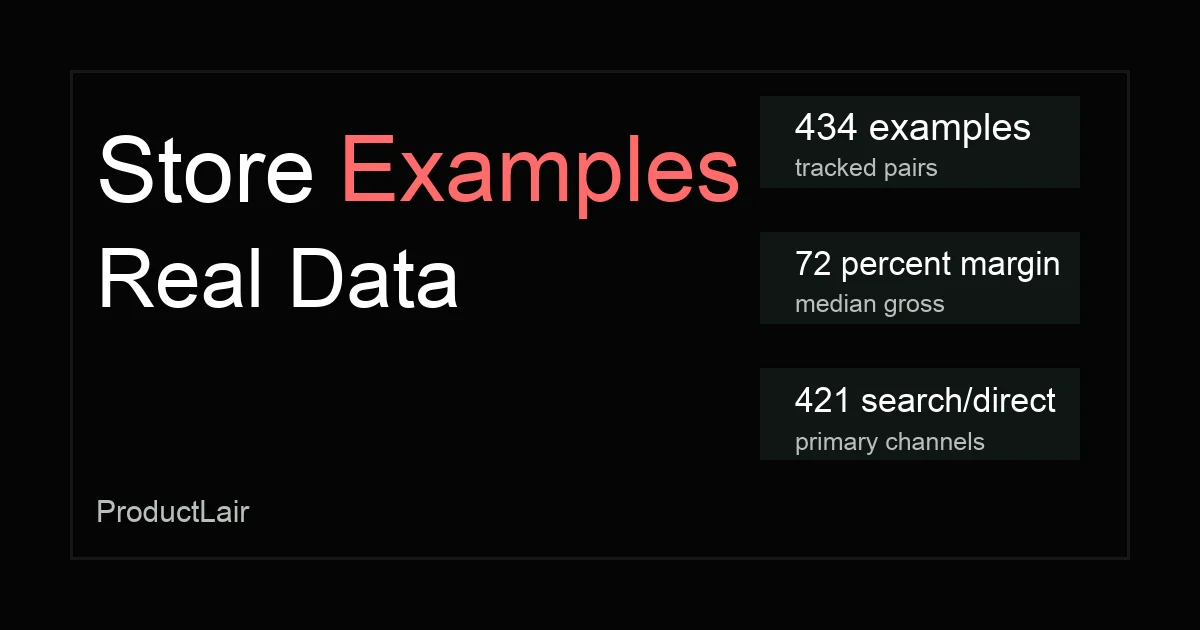
We analyzed 434 dropshipping store examples to compare real margins, traffic channels, product fit, and what successful Shopify stores do differently.
How to start dropshipping in 2026 with 5,943-product data, cost ranges, product filters, supplier checks, and a beginner launch plan.